










Best places to live in Surrey: A buying agent’s guide
The best places to live in Surrey each give a buyer something specific: a fast train into Waterloo, a...
Buying a distressed property can be an appealing route for buyers who want to create a home that reflects how they live, rather than adapting themselves to someone else’s choices. The appeal is often clear: a lower purchase price, a strong location, and the opportunity to reconfigure and modernise over time.
In practice, buying a renovation project is rarely straightforward. It requires clarity, realism, and an understanding of what you are taking on before you commit.

The term distressed property is used widely and can mean different things to different buyers. For some, it refers to a house that needs cosmetic updating, such as new kitchens, bathrooms, and decoration. For others, it describes a property requiring more extensive work, including rewiring, damp remediation, or structural alterations.
Before beginning your search, it is worth being clear about where your comfort level sits.
Buyers often view properties that turn out to be far more involved than expected, or conversely, not involved enough to justify the disruption they are prepared to accept.
Being clear about the level of work you are willing to undertake can save time and reduce the risk of pursuing unsuitable properties.
When buying a property to renovate, the scale of work is just as important as the purchase price.
Light refurbishment projects are generally more predictable and easier to plan for. Properties requiring major structural works, extensions, or full internal reconfiguration tend to involve greater cost uncertainty and longer timescales.
It is also important to consider how you plan to live during work. Some buyers are comfortable vacating entirely, while others need a property that can be improved in stages.
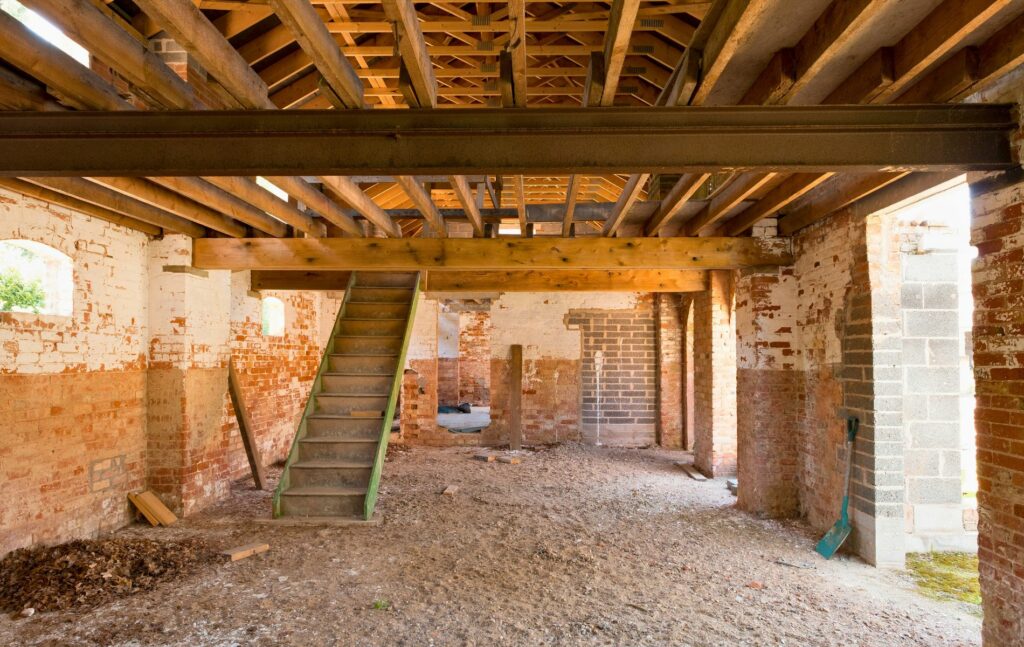
Early due diligence plays an important role when buying a distressed property.
Planning constraints are a common issue. Buyers sometimes assume that extensions or alterations will be acceptable, only to discover that the property sits within a conservation area or is listed.
In these cases, additional controls may apply, and permitted development rights can be restricted or removed, for example, through an Article 4 direction.
While many constraints can be checked at an early stage, feasibility will always depend on the specific proposals.
It is also worth being cautious about assumptions around value. The idea that what is saved on the purchase price will automatically fund the renovation does not always hold true, particularly where costs increase once work begins.

Involving professionals early can help buyers understand risk more clearly.
A second viewing with a builder, architect, or design and build company may provide useful early insight.
Some professionals are able to give broad cost ranges based on plans or property particulars, which can help rule out unsuitable opportunities before significant costs are incurred.
Basing refurbishment budgets solely on instinct or rough assumptions, without professional input, can lead to difficult decisions later.
Not necessarily. In sought-after locations, distressed properties can attract strong interest. Probate properties, repossessions, and unmodernised houses in established neighbourhoods are sometimes subject to competitive bidding and may be sold via sealed bids.
When making an offer, it is important to factor in realistic build costs, professional fees, and a contingency allowance, rather than focusing solely on the purchase price.
Financing is an important consideration when buying a distressed property.
Some lenders may be unwilling to offer mortgages on properties that lack basic facilities or require substantial work before they are considered habitable.
What constitutes “habitable” can vary by lender and valuation
Therefore, an agreement in principle does not always guarantee funding for a full renovation project.
Discussing the type of property you are considering with a broker or lender at an early stage can help avoid delays or disappointment later.
Even relatively modest refurbishment projects can uncover unexpected issues.
Older wiring, outdated plumbing, ageing boilers, and structural concerns are not always obvious during viewings. For this reason, we consistently recommend instructing a surveyor, even where buyers feel confident about the work required.
If a survey recommends further investigation by a structural engineer or specialist, it is usually sensible to proceed.
Understanding the scope of works allows buyers to plan more accurately and, where appropriate, consider whether the agreed price still reflects the condition of the property.

For those buying with resale or rental in mind, margins matter.
Understanding the local property market is just as important as understanding the building itself. Family houses need to function as such, while rental properties should suit their likely tenants in layout and specification.
When buying a distressed property purely as an investment, personal preferences can be costly. Successful projects tend to be those approached objectively, with decisions guided by demand rather than taste.
Distressed properties often arise through probate, repossession, or long-term underinvestment. They can be found at auction, through local agents, and, at times, on the open market.
Relying solely on property portals may limit opportunities.
In practice, suitable renovation projects are sometimes identified through local knowledge, professional networks, and proactive searching.
As property finders acting exclusively for buyers, we help clients consider refurbishment potential before committing to a purchase. This includes understanding planning constraints, likely costs, and whether a project is likely to be viable.
If you are considering buying a distressed property and would value informed advice before you proceed, our team would be pleased to help.
Please get in touch for a no-obligation discussion about your plans.
The best places to live in Surrey each give a buyer something specific: a fast train into Waterloo, a...
When searching for a property with stables, the natural instinct is to begin with the house: the kitchen, the...
The common mistakes property buyers make are rarely dramatic. More often, they are small misjudgements early in a search...
There are many locations across the UK that offer a 60 minute commute to London, and the choice between...