










Where the UK Property Market Divides This Autumn
Welcome to Garrington’s September UK Property Market Review. Following the usual seasonal lull in August, summer...
Welcome to Garrington’s August UK property Market Review. The summer holidays usually draw attention away from house hunting, and this year the pause coincides with unsettled borrowing costs, a change of Prime Minister and an Autumn Budget now in the diary.
Our analysis reads that as a window for buyers able to proceed with clarity rather than a market losing momentum, though a selective one by location and price bracket.
This month’s house price indices agree that growth has softened, though they differ on the extent. Nationwide shows annual growth slowing to 1.8% in July, while Lloyds puts it at 0.1%, its slowest since November 2023.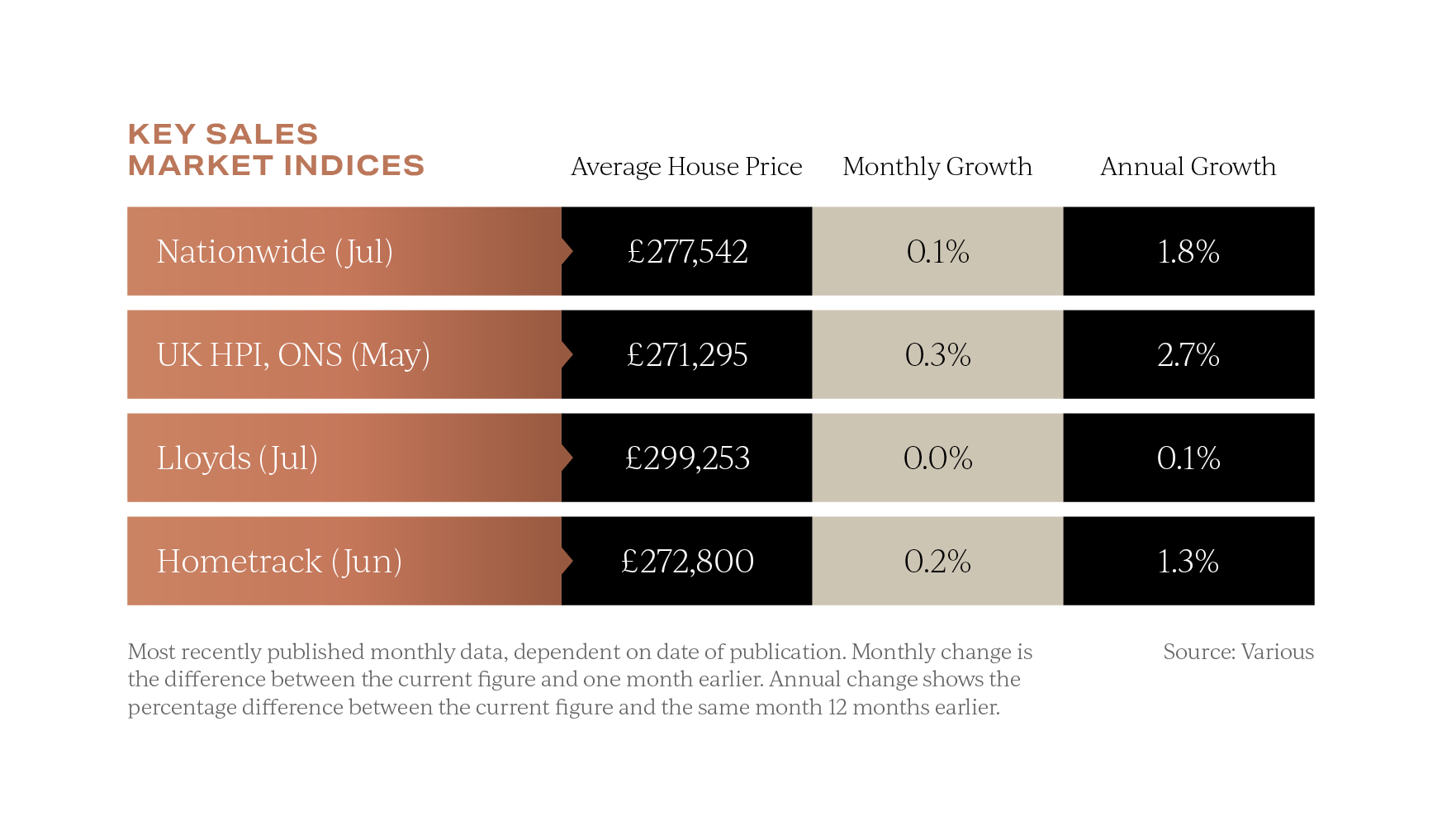 Zoopla places annual growth at 1.3%, with higher mortgage rates and political uncertainty giving buyers reasons to hesitate. Sellers have drawn the same conclusion, with Rightmove data showing a cut in new asking prices of 1.0% in July, a larger fall than usually seen. Garrington reads this as sellers responding of their own accord, which tends to favour buyers willing to proceed over those waiting for lower prices.
Yet activity has not disappeared, with sales agreed in the first half of the year down 6% on 2025 but level with 2024, and committed purchasers still act where property, price and circumstances align.
Mortgage approvals held up well through early 2026 before faltering in May, when Bank of England figures show them falling 15% in a single month to leave volumes 8% below their five-year average.
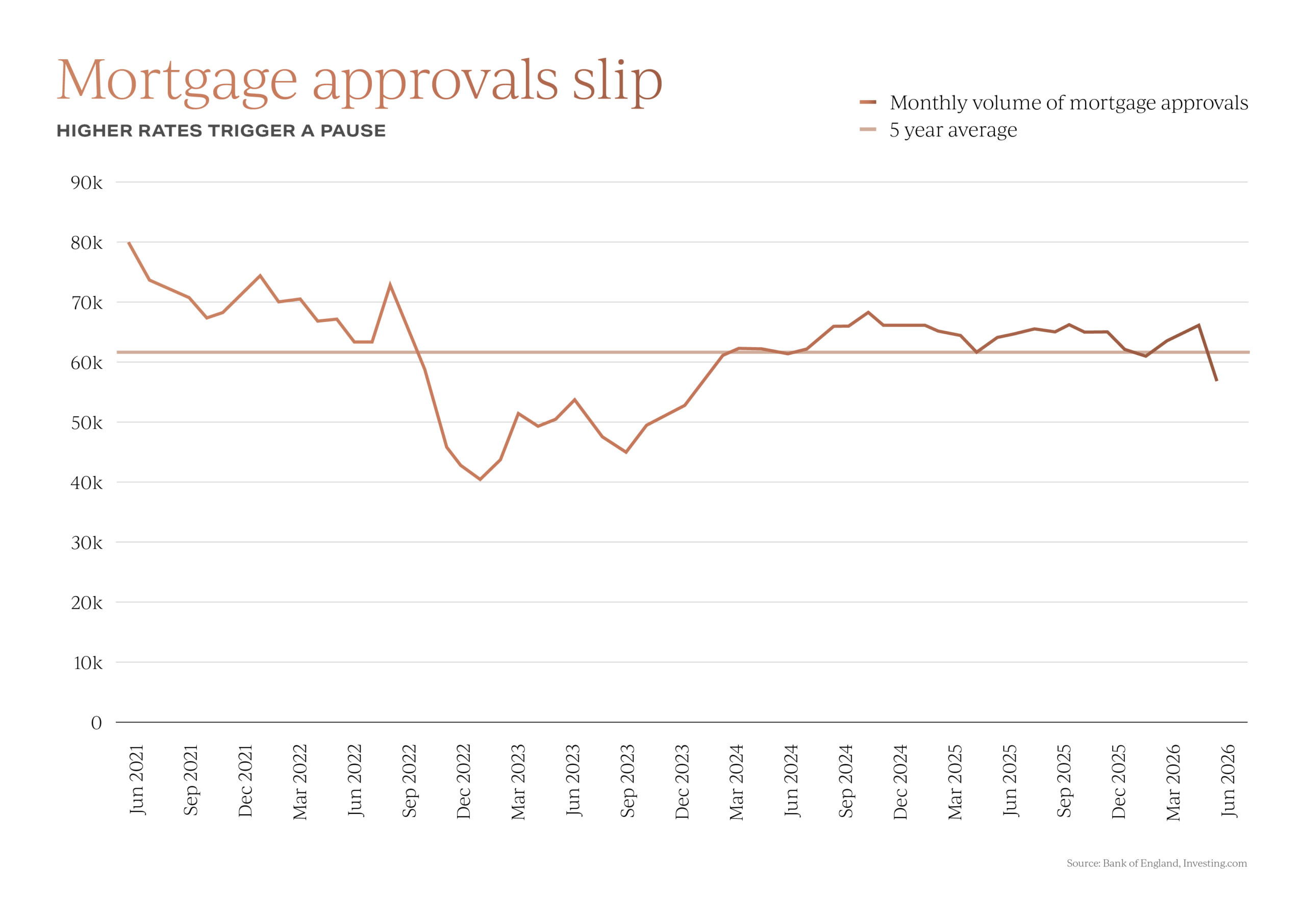
The trigger for this sat in the cost of credit rather than in appetite to move. Concern over imported inflation following recent global events pushed average weekly swap rates, the benchmark for fixed mortgage pricing, from 3.8% to 4.7% in mid-May. Borrowers felt the effect within weeks, before the benchmark eased back to 4.4% by early July.
June’s RICS survey has buyer enquiries at their least downbeat since February while still firmly negative, supporting the reading that the disruption came from outside the housing market and should ease as that pressure does, though any improvement is likely to stay fragile while global uncertainty persists.
It is a reminder of how quickly affordability moves, and Garrington’s experience is that those with finance arranged are better placed to act while a good rate is available, whereas those waiting for certainty find it arrives with competition.
Finding the right property is now only part of the challenge. TwentyCi reports that 60.8% of properties reaching exchange in 2026 took over six months from instruction, up sharply from 36.1% in 2019, and the stretch to completion pushes the journey out to seven months.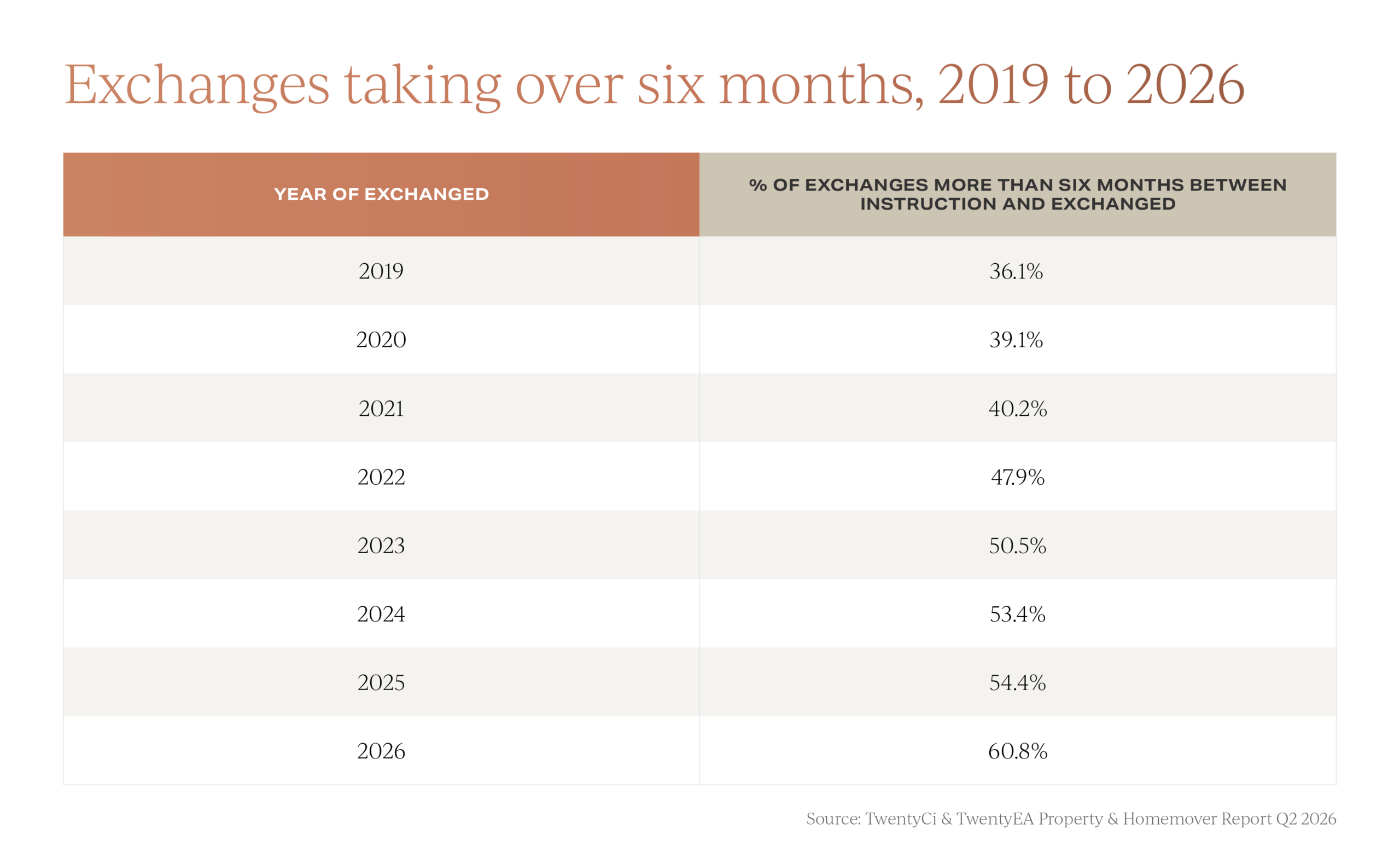 That proportion has risen every year since 2019, and a longer timetable leaves mortgage offers, chains and confidence exposed. The Home Buying and Selling Reform roadmap we covered in July targets this, though upfront information and binding contracts will take time.
There is an encouraging counterweight in the same report, with fall-throughs in the second quarter running 8.7% below last year.
Fewer buyers are in the market, but those agreeing terms are more committed.
And the chains which hold, in our experience, are those actively managed from the moment terms are agreed.
Pricing remains the other half of the equation. Rightmove found nearly three-quarters of homes completing this year did so without a reduction, with correctly priced homes finding a buyer in 36 days against 127 for those needing a cut.
London’s headline figure again hides as much as it shows. ONS figures for May have prices across the capital down 3.7% over the year, against 5.9% growth in the North East and strong gains across the north.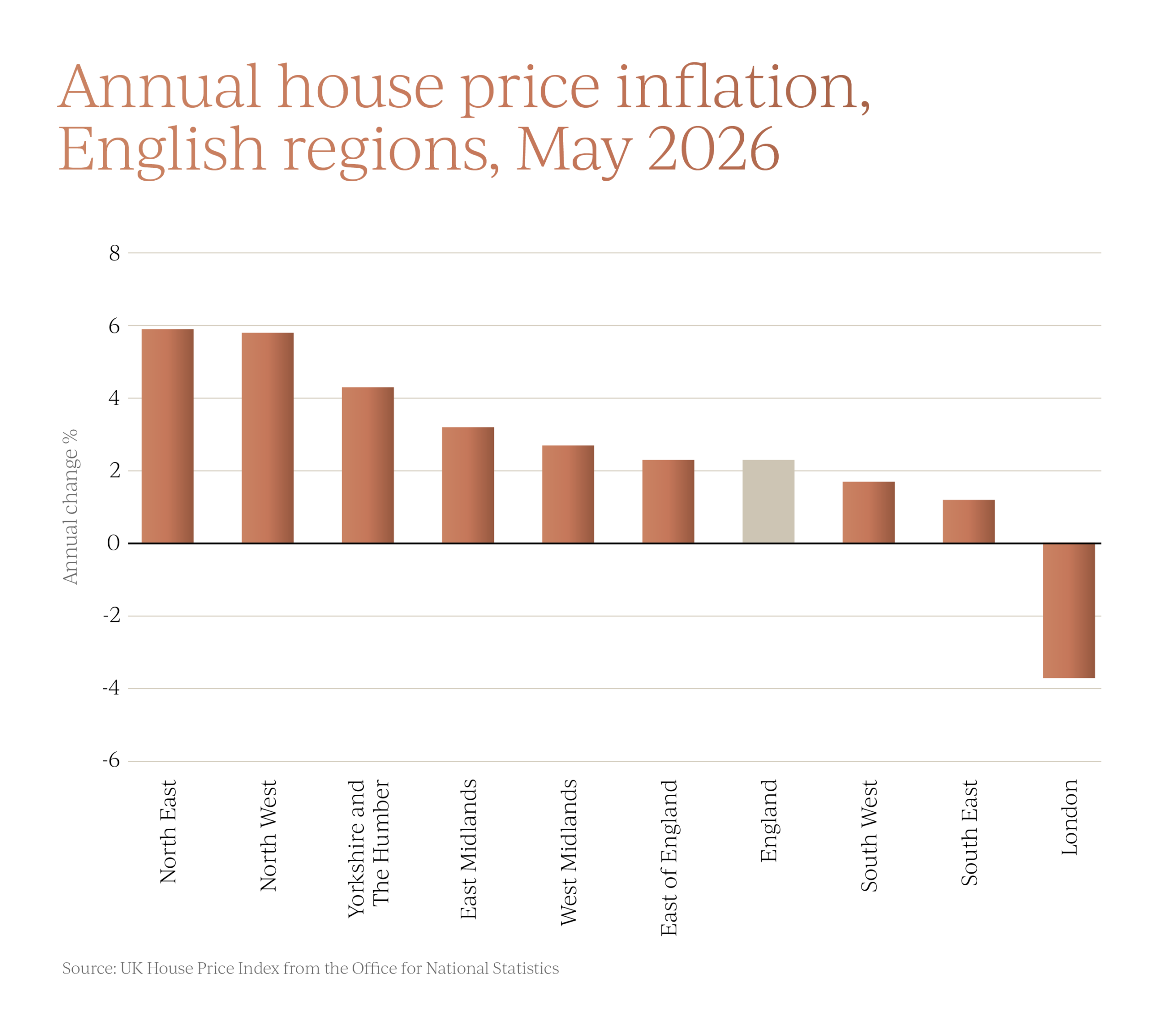 Property type adds another layer, with Hometrack recording flat values down 1.7% across the UK while terraced and semi-detached homes rose. Garrington is seeing buyer caution around flats with high service charges or uncertain resale prospects, while well-positioned family houses attract interest.
At the upper end, industry data points to renewed activity, though buyers negotiate hard.
Within the £15 million-plus segment, the average discount from asking to achieved has widened to 16.2%, from 8.1%.
Those readings only look contradictory if the capital is treated as one market. A scarce trophy asset and a competitively supplied flat answer to different buyers, so a London buyer negotiates against the circumstances of one property rather than a citywide trend.
Speculation about property taxation has run through the summer, and the Budget now has a date of 28th October.
The Prime Minister has ruled out changes to Stamp Duty Land Tax at the Budget, while Downing Street has denied reports that a proportional property or land value tax is under consideration. That settles the immediate question for higher-value buyers, but not the longer-term one.
A confirmed date without confirmed detail is, in our experience, what keeps discretionary buyers waiting, particularly in London and above £2 million, while motivated sellers grow more receptive to a well-argued offer.
Supply and confidence will shape the UK property market over the coming months, more than headline prices, and both sit in the buyer’s favour for now, with borrowing costs off their spring peak and sellers’ pricing adjusting to market conditions.
What we expect to narrow is the choice itself, as fewer sellers bring homes forward before the Budget, leaving a selective opportunity for buyers who are financially prepared, realistic about timing and well advised locally.
If you’ve set a search aside this summer, or have been looking without success, the Garrington team would be delighted to help. Please get in touch to discuss how these conditions apply to your own plans.
We look forward to sharing our latest insights next month.
Welcome to Garrington’s September UK Property Market Review. Following the usual seasonal lull in August, summer...
Welcome to Garrington’s July UK Property Market Review. Summer is now in full swing, bringing Wimbledon, the cricket, a...
Welcome to Garrington’s June UK property market review, where another month of competing data and conflicting headlines is...